



Community hub
Recent from talks
Knowledge base stats:
Talk channels stats:
Members stats:
Circuit breaker
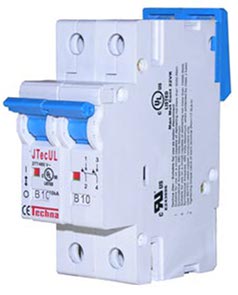
A circuit breaker is an electrical safety device designed to protect an electrical circuit from damage caused by current in excess of that which the equipment can safely carry (overcurrent). Its basic function is to interrupt current flow to protect equipment and to prevent fire. Unlike a fuse, which interrupts once and then must be replaced, a circuit breaker can be reset (either manually or automatically) to resume normal operation.
Circuit breakers are commonly installed in distribution boards. Apart from its safety purpose, a circuit breaker is also often used as a main switch to manually disconnect ("rack out") and connect ("rack in") electrical power to a whole electrical sub-network.
Circuit breakers are made in varying current ratings, from devices that protect low-current circuits or individual household appliances, to switchgear designed to protect high-voltage circuits feeding an entire city. Any device which protects against excessive current by automatically removing power from a faulty system, such as a circuit breaker or fuse, can be referred to as an over-current protection device (OCPD).
An early form of circuit breaker was described by Thomas Edison in an 1879 patent application, although his commercial power distribution system used fuses. Its purpose was to protect lighting circuit wiring from accidental short circuits and overloads. A modern miniature circuit breaker similar to the ones now in use was patented by Brown, Boveri & Cie in 1924. Hugo Stotz, an engineer who had sold his company to Brown, Boveri & Cie, was credited as the inventor on German patent 458392. Stotz's invention was the forerunner of the modern thermal-magnetic breaker commonly used in household load centers to this day.
Interconnection of multiple generator sources into an electrical grid required the development of circuit breakers with increasing voltage ratings and increased ability to safely interrupt the increasing short-circuit currents produced by networks. Simple air-break manual switches produced hazardous arcs when interrupting high-voltage circuits; these gave way to oil-enclosed contacts, and various forms using the directed flow of pressurized air, or pressurized oil, to cool and interrupt the arc. By 1935, the specially constructed circuit breakers used at the Boulder Dam project used eight series breaks and pressurized oil flow to interrupt faults of up to 2,500 MVA, in three AC cycles.
All circuit breaker systems have common features in their operation, but details vary substantially depending on the voltage class, current rating and type of the circuit breaker.
The circuit breaker must first detect a fault condition. In small mains and low-voltage circuit breakers, this is usually done within the device itself. Typically, the heating or magnetic effects of electric current are employed. Circuit breakers for large currents or high voltages are usually arranged with protective relay pilot devices to sense a fault condition and to operate the opening mechanism. These typically require a separate power source, such as a battery, although some high-voltage circuit breakers are self-contained with current transformers, protective relays, and internal power sources.
Once a fault is detected, the circuit breaker contacts must open to interrupt the circuit; this is commonly done using mechanically stored energy contained within the breaker, such as a spring or compressed air to separate the contacts. A breaker may also use the higher current caused by the fault to separate the contacts, via thermal expansion or increased magnetic field. A small circuit breaker typically has a manual control lever to switch the circuit off or reset a tripped breaker, while a larger unit may use a solenoid to trip the mechanism, and an electric motor to restore energy to springs (which rapidly separate contacts when the breaker is tripped).
Hub AI
Circuit breaker AI simulator
(@Circuit breaker_simulator)
Circuit breaker
A circuit breaker is an electrical safety device designed to protect an electrical circuit from damage caused by current in excess of that which the equipment can safely carry (overcurrent). Its basic function is to interrupt current flow to protect equipment and to prevent fire. Unlike a fuse, which interrupts once and then must be replaced, a circuit breaker can be reset (either manually or automatically) to resume normal operation.
Circuit breakers are commonly installed in distribution boards. Apart from its safety purpose, a circuit breaker is also often used as a main switch to manually disconnect ("rack out") and connect ("rack in") electrical power to a whole electrical sub-network.
Circuit breakers are made in varying current ratings, from devices that protect low-current circuits or individual household appliances, to switchgear designed to protect high-voltage circuits feeding an entire city. Any device which protects against excessive current by automatically removing power from a faulty system, such as a circuit breaker or fuse, can be referred to as an over-current protection device (OCPD).
An early form of circuit breaker was described by Thomas Edison in an 1879 patent application, although his commercial power distribution system used fuses. Its purpose was to protect lighting circuit wiring from accidental short circuits and overloads. A modern miniature circuit breaker similar to the ones now in use was patented by Brown, Boveri & Cie in 1924. Hugo Stotz, an engineer who had sold his company to Brown, Boveri & Cie, was credited as the inventor on German patent 458392. Stotz's invention was the forerunner of the modern thermal-magnetic breaker commonly used in household load centers to this day.
Interconnection of multiple generator sources into an electrical grid required the development of circuit breakers with increasing voltage ratings and increased ability to safely interrupt the increasing short-circuit currents produced by networks. Simple air-break manual switches produced hazardous arcs when interrupting high-voltage circuits; these gave way to oil-enclosed contacts, and various forms using the directed flow of pressurized air, or pressurized oil, to cool and interrupt the arc. By 1935, the specially constructed circuit breakers used at the Boulder Dam project used eight series breaks and pressurized oil flow to interrupt faults of up to 2,500 MVA, in three AC cycles.
All circuit breaker systems have common features in their operation, but details vary substantially depending on the voltage class, current rating and type of the circuit breaker.
The circuit breaker must first detect a fault condition. In small mains and low-voltage circuit breakers, this is usually done within the device itself. Typically, the heating or magnetic effects of electric current are employed. Circuit breakers for large currents or high voltages are usually arranged with protective relay pilot devices to sense a fault condition and to operate the opening mechanism. These typically require a separate power source, such as a battery, although some high-voltage circuit breakers are self-contained with current transformers, protective relays, and internal power sources.
Once a fault is detected, the circuit breaker contacts must open to interrupt the circuit; this is commonly done using mechanically stored energy contained within the breaker, such as a spring or compressed air to separate the contacts. A breaker may also use the higher current caused by the fault to separate the contacts, via thermal expansion or increased magnetic field. A small circuit breaker typically has a manual control lever to switch the circuit off or reset a tripped breaker, while a larger unit may use a solenoid to trip the mechanism, and an electric motor to restore energy to springs (which rapidly separate contacts when the breaker is tripped).